Find the failed zone before it costs you plants, pavement, or another water bill.
Bryson diagnoses irrigation as a connected system: controller, valves, pressure, distribution, and coverage. That matters on Phoenix properties where one hidden failure can affect turf, desert plants, trees, tenant areas, and hardscape at the same time.
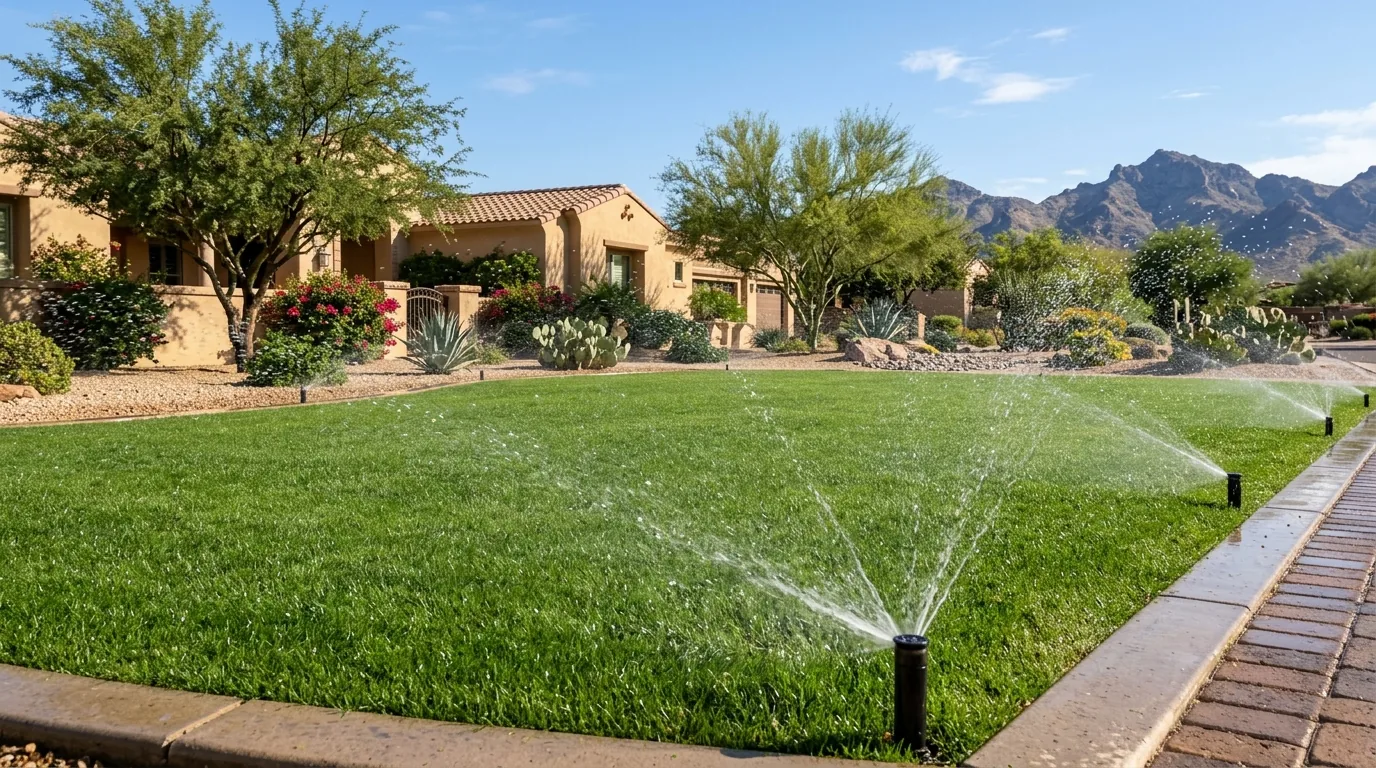
Phoenix irrigation failures rarely stay small for long.
A slow drip-line break can wash out soil beneath gravel. A valve that does not close can saturate roots and raise the water bill. A weak spray pattern can stress Bermuda turf long before the controller reports a problem. The repair needs to address both the failed component and the way the zone performs afterward.
Hidden water loss
Subsurface leaks, cracked fittings, and valves that seep after a cycle can waste water without producing an obvious spray or geyser.
Coverage breakdown
Mismatched heads, blocked arcs, pressure loss, and changed landscaping can leave dry areas beside oversaturated ones.
Control failure
A controller may call for water while a wiring, solenoid, valve, or flow problem prevents the landscape from receiving it.
Repair the component, then prove the zone works.
Phoenix systems range from compact home drip loops to multi-zone commercial landscapes. We shape the diagnostic around the property instead of forcing every job into a one-size service call.
Leak tracing and isolation
Inspect active symptoms, valve behavior, accessible piping, and pressure changes to narrow the failure before excavation or replacement.
- Main and lateral concerns
- Valve-box saturation
- Drip and fitting failures
Valve and manifold repair
Correct valves that leak, stick, chatter, fail to open, or fail to close, including related solenoids and damaged manifold connections.
- Diaphragm and solenoid evaluation
- Fitting repair
- Manifold replacement planning
Sprinkler and rotor correction
Replace damaged heads, match nozzles, adjust arcs, correct tilt, and review head-to-head coverage where turf performance is uneven.
- Broken heads
- Low or uneven spray
- Pavement overspray
Drip distribution repair
Repair split tubing, missing emitters, weak branches, and plant delivery points affected by heat, maintenance activity, roots, or landscape changes.
- Poly and emitter repair
- Tree and shrub delivery
- Exposed-line cleanup
Controller troubleshooting
Review programs, station response, seasonal runtimes, and accessible controller or field connections that may be interrupting a zone.
- Station mapping
- Schedule correction
- Controller replacement options
Commercial irrigation response
Coordinate access and repair scope for offices, retail, multifamily, community spaces, and other managed Phoenix properties.
- Tenant and gate coordination
- Priority leak isolation
- Repair notes for decision-makers
Phoenix landscapes create multiple watering environments on one address.
A west-facing planter beside reflective pavement behaves differently from a shaded courtyard. Turf, desert trees, flowering shrubs, and pots may all have different delivery needs. When those areas share the wrong zone or runtime, the visible damage can look like a broken line even when the deeper problem is the layout.
We account for surface heat, plant type, changed bed lines, buried or exposed tubing, hardscape crossings, and the practical access needed to reach valves and controllers. On managed properties, we also identify what can be repaired immediately and what should be budgeted as a separate system improvement.
A repair process designed for accountable decisions
Every step should make the next decision clearer—for the homeowner, facility contact, property manager, or board.
01 / Intake
Identify the symptoms, property type, affected landscape, urgency, controller location, and access requirements.
02 / System test
Operate relevant stations and check the field components that connect the controller command to water delivery.
03 / Scope choices
Separate the immediate repair from optional coverage corrections, upgrades, or aging-system replacements.
04 / Verification
Cycle repaired zones, inspect coverage or shutoff behavior, and document the settings or follow-up work discussed.
Send enough detail for us to route the right irrigation visit.
A commercial valve failure and a broken residential drip line require different preparation. Tell us what the system serves and what happens when the affected station runs.
- Residential or commercial property
- Number of affected zones, if known
- Leak, dry zone, controller, valve, or coverage symptom
- Photos of controller and visible damage
- Water shutoff and valve-box access
- Site-contact or tenant coordination needs
Straight answers about the service
Do you provide commercial irrigation repair in Phoenix?+
Yes. Bryson can evaluate irrigation issues for offices, retail centers, multifamily properties, community spaces, and other managed sites. Include access, site-contact, and documentation requirements in the request.
Can you repair a system if I do not know where the valves are?+
Often, but locating buried or undocumented components can add diagnostic time. Share any old plans, controller labels, previous invoices, or knowledge from the prior owner or landscaper.
Why does one sprinkler zone have both dry and soggy areas?+
Possible causes include pressure loss, mismatched nozzles, blocked spray, tilted heads, poor spacing, a lateral leak, or a runtime that is wrong for the soil and exposure. Testing the full zone is more useful than replacing one head.
Do you work on smart irrigation controllers?+
We can review station setup and basic programming and discuss controller replacement or upgrade options. Compatibility depends on the existing valves, wiring, internet access, and the needs of the property.
Can an irrigation repair be completed during the first visit?+
Many defined repairs can be, but buried damage, large manifolds, unavailable parts, access limitations, or failures discovered during testing may require a follow-up scope.
Should irrigation be checked before a landscape installation?+
Yes. New plants, turf, or beds should not be installed around an unreliable distribution system. Irrigation capacity, zone design, and coverage should be resolved as part of installation planning.
Plan your next step
Practical guides to help you prepare for this service.
Phoenix Irrigation Checklist After Monsoon Rain
Check rain delays, drip lines, sprinklers, and lingering wet spots after a Phoenix monsoon storm before restarting your normal irrigation routine.
Irrigation RepairDrip Irrigation Maintenance: How to Spot and Fix Hidden Tube Leaks
Don't let silent water leaks spike your utility bills. Learn how to perform a simple monthly pressure test and maintain emitter lines in the Arizona heat.
Continue planning the property
Ready for a property-specific answer?